St. James's Congregation
What is the United Reformed Church?
- History
History of St James's Church
St James’s Church is the oldest non-conformist church in the city, tracing its origins back to 1684. The congregation’s origins lie in a number of sources, including an independent chapel of 1744 and a ‘protestant dissenting’ congregation which met in a malt loft in Silver Street in 1684 (see inside the church for a copy of the “preaching licence” signed by King Charles II to allow the congregation to meet legally).
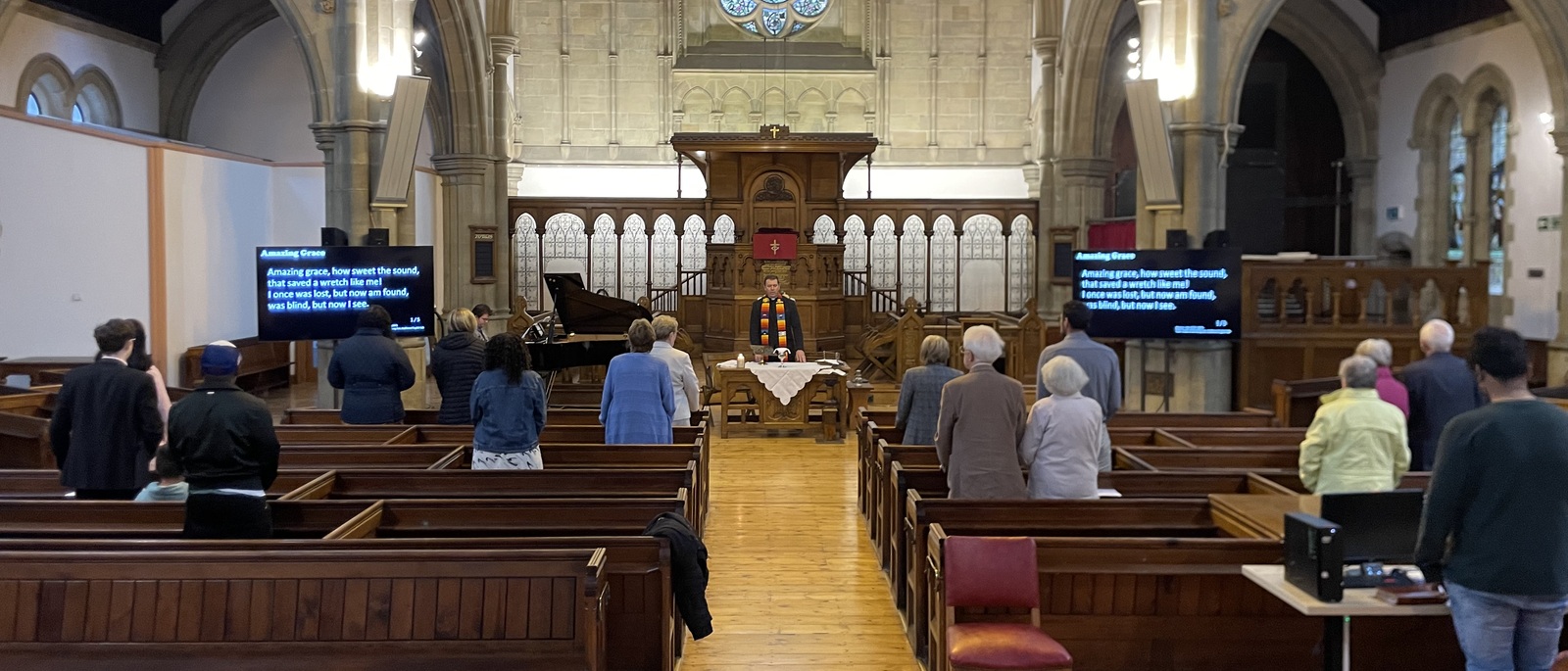
The name St. James's was adopted in 1832 when the congregation moved from Silver Street to a new Chapel near Grey’s Monument at the junction of Blackett Street and Grainger Street. In 1859 this was demolished as there was no provision for Sunday School or meetings during the week and a new church built on the site. However the acoustics were not good and it was decided to build a 3rd St. James’s. It was decided to buy a site in Bath Road (now Northumberland Road) on the grounds of the old County Cricket Club. The foundation stone was laid in 1882 and the church was completed 18 months later and opened in 1884. The cost was £18,000, of which £6,500 was redeemed from the sale of the Blackett Street church to the YMCA. The building is currently a Grade 2* listed building.
St. James’s was accustomed to having outstanding preachers and Dr. John Henry Jowett was called and began his ministry in 1889, and during his ministry the church membership rose to over 530. Music has always played a large part in the church and a fine pipe organ was installed. Several societies and Reading, Literary and Debating groups were formed, especially to encourage young people and St. James’s turned their attention to helping the disadvantaged in the city with examples of practical Christianity.
During the Great War (1914-1918) St. James’s had all its premises commandeered (they were situated between two army drill halls and the congregation was left with the church only. One room was used as a recreation room for the troops and St. James’s members sent a magazine with home news to every man who was conscripted there.
St. James’s lost several members who did not return from the armed forces. And in 1922 new choir stalls bearing the names of those who gave their lives were dedicated as a War Memorial, During the post-war years the church became to be more politically aware and had several speakers of national renown. Many activities took place including visits to the Home for Incurables and the development of the Pandon Mission which became a church in its own right.
When war was declared in 1939, the premises were commandeered once more, this time by the Ministry of Works. Difficult times demanded that church volunteers should spend the night in two’s, to carry out fire-fighting duties as incendiary bombs were prevalent.
Discussions began to take place regarding union of Congregational and Presbyterian churches. During this time the City Council proposed a new development which included the demolition of St. James’s and Trinity Presbyterian church. Opposition to this proposal received much support and the proposal was finally thrown out.
In 1967 the Revd. Dr. Erik Routley, known for his fine scholarship and musicianship was inducted and St. James’s Choir was admitted to the Royal School of Church Music – the first non-conformist choir to be so honoured. Dr. Routley became Chairman of the Congregational Union of England and Wales. In 1973 a four manual, electronic organ made by Copeman Hart was built and installed to the specification of Dr. Routley and Mr. Raymond Hall the then organist.
In 1972 the Congregational Church and the Presbyterian Church of England, united to form the United Reformed Church, which in 1981 united with the re-formed Association of the Churches of Christ, becoming the United Reformed Church in the United Kingdom, or URC for short.
In 1997 St. James’s underwent a major refurbishment, allowing the opportunity of rooms to be let to other organisations and beliefs. Now the Northern Lights Metropolitan Community Church, the Newcastle Chinese Christian Fellowship and Newcastle Dream Church hold their worship at St. James’s.
In 2008 St. James’s joined with St. Andrew’s URC to form a joint pastorate with the Revd. James Breslin as Minister. He held the ministry of St James's from 1990 to 2018. After his retirement the joint pastorate had a period of vacancy, finally uniting with Jesmond URC and West End URC to form the North, West and Central Newcastle pastorate, with the appointment of the Revd. Ryan Sirmons as minister of the pastorate in 2021.